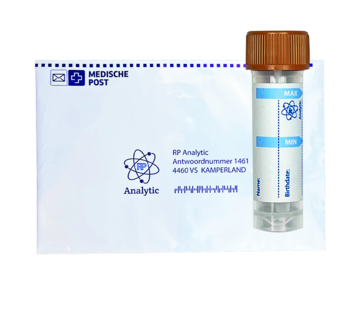
Colorectal cancer test IFOBT
Don't want to wait for the population screening and request a colorectal cancer test (IFOBT) yourself?
Then take the colorectal cancer screening test, by sending a little stool to our laboratory. It's as simple as passing a mascara roller through your stool, putting it in the tube and then sending the tube by mail to the lab.
For more information about this test read herehttps://info.bloodtesting.nl/darmkankerzelftest/
Starting in 2014, Dutch people between the ages of 55 and 75 will receive a call every two years to submit stool samples. This stool will be checked for blood traces. Blood traces can possibly indicate colon cancer, but may also have another cause.
This test is only for people up to age 55, after that you are covered by the population screening, where you will be tested for colon cancer for free every two years until age 75. Read information about the population screening here . The gold standard for follow-up testing after a positive result from the population screening is a colonoscopy. If you have blood traces in your stool, you will be offered further investigation into the cause of the blood traces.
When you will receive an invitation depends on the year of your birth. If you don't want to wait for this, you can also order this test yourself here.
Participants receive a stool test, which they themselves send to the laboratory for analysis. If blood is found in the stool, the test result is positive. In that case they are referred for further investigation, diagnosis and if necessary treatment.
The stool test is only intended for people who have no complaints.
Click here for instruction Dutch
click here for instruction in English
click here for more information from the gastro liver intestinal foundation
The iFOBT test is NOT intended for risk groups.
A person belongs to a risk group if they: have had colon cancer or colon polyps before or have complaints such as:
- visible blood loss in the stool
- empty urge
- unexplained weight loss
- anemia
- if the stool pattern has changed recently
- has a first-degree relative (father, mother or child) who has contracted bowel cancer before the age of 50.
- two first-degree relatives who developed colon cancer after the age of 50.
- knows that there is a form of hereditary colon cancer in the family.
In all these cases, careful examination is needed, usually including a bowel examination. Your family doctor will refer you for this. An iFOBT test does not provide sufficient certainty in these cases.
You better not collect a sample of your stool if you see blood in your
stools due to menstruation.
Hemoglobin in feces (IFOBT) ELISA reference value <50 ng/ml
Below 50, the result is negative, meaning good. This is called the cutoff value. Anything below that number is negligible. If something does happen, you will be called first.