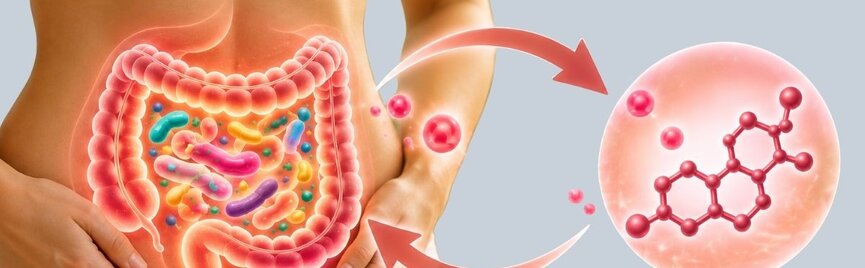
What do your intestines have to do with your estrogen levels?
Gut bacteria can help determine how much processed estrogen is excreted or reabsorbed. Microbiome testing, urine testing for metabolites, and hormone testing each shed light on a different aspect of this interaction.
When we experience hot flashes, changes in our menstrual cycle, mood swings, or weight gain, we tend to think of hormones right away. When we have a bloated stomach, constipation, or diarrhea, we look to the gut. But it’s becoming increasingly clear that these two systems don’t function independently of one another.
This is because gut bacteria can influence the way estrogens are processed and excreted. Conversely, hormonal changes can alter the composition and function of the gut microbiome.
Scientists refer to this interaction as the microbiome-estrogen axis. This is a particularly interesting area of research during menopause. It does not mean that all hormonal symptoms originate in the gut. However, it does show why diet, gut health, liver function, and hormones sometimes need to be considered together.
What is the microbiome-estrogen axis?
The gut microbiome consists of trillions of bacteria and other microorganisms that live in your gut. Among other things, they help with:
- the breakdown of dietary fiber;
- the production of short-chain fatty acids;
- maintaining the intestinal lining;
- supporting the immune system;
- the processing of bile acids, medications, and hormones.
Part of the gut microbiome is involved in the processing of estrogens. This is called the estrobome.
The estroboloom is neither a separate organ nor a specific type of bacteria. It is a collective term for gut bacteria and bacterial functions that can influence the excretion and reabsorption of estrogens.
How the Liver, Gut, and Estrogen Work Together
After estrogens have performed their function in the body, they are processed by the liver. The liver binds the hormones to other substances so that they can be excreted via bile and feces.
Once in the gut, certain bacteria can produce enzymes that break this bond. An important enzyme involved in this process is beta-glucuronidase.
When estrogens are re-released in the gut, some of them can be reabsorbed through the intestinal wall. They then re-enter the bloodstream. This process is called the enterohepatic circulation.
In a nutshell:
- Estrogens circulate throughout the body.
- The liver prepares them for excretion.
- They enter the gut via the bile.
- Gut bacteria can release some of it again.
- Released estrogen can be excreted or reabsorbed.
The activity of gut bacteria can therefore help determine how much processed estrogen leaves the body and how much re-enters the bloodstream.
Does a higher level of beta-glucuronidase automatically mean more estrogen?
No. The body is too complex for that.
The amount of estrogen in the body is also determined by:
- ovarian function;
- age and life stage;
- the menstrual cycle;
- adipose tissue;
- liver function;
- body weight;
- alcohol consumption;
- medication;
- hormonal birth control or hormone therapy;
- Genetic factors.
We also do not yet know what the optimal amount of beta-glucuronidase is for each woman. Therefore, the presence of bacteria that can produce this enzyme does not prove that someone has too much estrogen.
The estroboloom is one link in a much larger system.
The interaction works both ways
Gut bacteria can influence the metabolism of estrogens, but estrogens, in turn, affect the gut.
Estrogens may play a role in:
- the composition and diversity of the microbiome;
- intestinal motility;
- the intestinal mucosa;
- the gut’s barrier function;
- immune and inflammatory processes.
This may partly explain why some women notice changes in their digestion during perimenopause or menopause. These changes can include bloating, constipation, looser stools, or an altered reaction to certain foods.
A recent scientific review describes links between menopause, the gut microbiome, and estrogen metabolism. At the same time, the researchers emphasize that no universal “healthy menopausal microbiome” has yet been identified. Age, ethnicity, lifestyle, and diet account for significant individual differences. Read the scientific review: https://pubmed.ncbi.nlm.nih.gov/41978103/
What symptoms might occur at the same time?
Changes in hormones and gut function can occur during the same stage of life. Possible symptoms include:
- changes in or irregular menstrual cycles;
- hot flashes and night sweats;
- breast tenderness;
- mood swings;
- poorer sleep;
- weight gain around the abdomen;
- a bloated stomach;
- constipation or irregular bowel movements;
- increased sensitivity to certain foods;
- fatigue;
- Joint pain.
These symptoms do not necessarily indicate that the estroboloom is out of balance. They may also be related to menopause itself, thyroid problems, iron deficiency, stress, lack of sleep, insulin resistance, medication, or a gut disorder.
That’s why it’s important not to conclude, based solely on symptoms, that you have “too much estrogen” or a “leaky gut.”
Can diet influence the microbiome-estrogen axis?
Diet is one of the most important factors you can use to influence the environment in which gut bacteria live. That doesn’t mean that a single food will restore your hormone balance. It’s your overall diet that matters.
Eat enough fiber
Fiber serves as a food source for various gut bacteria. The fermentation of fiber produces short-chain fatty acids, including butyrate. These substances support the intestinal wall and play a role in regulating inflammation.
Fiber also helps maintain regular bowel movements. When stool remains in the gut for a long time, there is more time for substances to be reabsorbed.
Good sources include:
- vegetables;
- fruit;
- legumes;
- whole grains;
- oats;
- Notes;
- seeds;
- ground flaxseed.
Build up your fiber intake gradually if your gut isn’t used to it yet.
Vary Your Intake of Plant-Based Foods
Different bacteria use different nutrients. Therefore, regularly alternating between vegetables, fruits, legumes, herbs, nuts, and grains supports a wider range of bacterial functions than eating the same thing every day.
It’s not just about the amount of plants, but also about the variety.
Eat fermented foods if you can tolerate them
Yogurt with live cultures, kefir, sauerkraut, kimchi, and other fermented foods can be part of a varied diet.
Not everyone reacts to this in the same way. If you have a sensitive gut, it’s wise to start with small amounts.
Think about polyphenols
Polyphenols are plant compounds found in, among other things:
- berries;
- grapes;
- green tea;
- cocoa;
- coffee;
- olive oil;
- herbs;
- colored vegetables.
Gut bacteria help convert these substances. This process produces metabolites that may affect the intestinal wall, inflammatory processes, and metabolism.
Soy and flaxseed don’t work the same way for everyone
Soy contains isoflavones, and flaxseed contains lignans. Gut bacteria can convert these plant compounds into compounds with a weak estrogen-like or estrogen-modulating effect.
Not everyone has exactly the same bacteria. As a result, one person may react differently to soy or flaxseed than another.
Common foods such as tofu, tempeh, soybeans, and ground flaxseed are not the same as highly concentrated supplements. If you have a hormone-sensitive condition or are taking medication, consult a doctor or pharmacist before using high-dose supplements.
Limit alcohol
Alcohol affects the liver, the intestinal barrier, and the microbiome. In addition, research has linked alcohol consumption to higher concentrations of certain sex hormones in women. View the meta-analysis: https://pubmed.ncbi.nlm.nih.gov/38824654/
Drinking less alcohol is therefore one of the most obvious lifestyle changes you can make to support both hormone metabolism and overall health.
Can you test the microbiome-estrogen axis?
There is no single test that can determine whether the entire microbiome-estrogen axis is “in balance.” However, various tests can each shed light on a specific aspect of it.
Microbiome research
The InnerBuddies microbiome test analyzes a stool sample to examine, among other things:
- the composition of gut bacteria;
- bacterial diversity;
- beneficial and potentially harmful groups of bacteria;
- bacterial functions and metabolic pathways;
- Functions related to fiber processing and short-chain fatty acids.
Based on the results, a questionnaire, and a food diary, personalized dietary recommendations can be developed.
The test does not measure estrogen. Nor can it prove that certain hormonal symptoms are caused by the microbiome. It provides insight into the gut environment and the bacterial functions that may be involved in the processing of estrogens.
Estrogen metabolites in urine
The estrogen metabolite test measures various breakdown products of estrogens in urine, including:
- 2-OHE1;
- 2-MeOE1;
- 4-OHE1;
- 4-MeOE1;
- 16α-OHE1;
- The ratio of 2-OHE1 to 16α-OHE1.
This test provides information about the pathways through which estrogens are metabolized and excreted. The results are determined not only by the microbiome, but also by the liver, hormone production, diet, body weight, medication, and genetic factors.
A urine test alone cannot therefore prove that the gut microbiota is responsible for hormonal symptoms.
Hormones in the Blood
Depending on your age, menstrual cycle, and symptoms, additional hormone testing may include:
- estradiol;
- FSH;
- LH;
- progesterone;
- SHBG.
Estradiol is a snapshot in time. In menstruating women and during perimenopause, levels can fluctuate significantly. Therefore, the day of the menstrual cycle and the use of hormonal birth control or hormone therapy must always be taken into account.
Liver and Metabolism
Because the liver processes estrogens, liver function tests can provide additional information. These include ALAT, ASAT, GGT, alkaline phosphatase, and bilirubin.
Glucose, HbA1c, and insulin may also be relevant. Insulin resistance and changes in body fat distribution are more common around menopause and can affect overall hormone balance.
Which combination provides the broadest insight?
Each of the different tests answers a different question:
| Test | Primarily answers the question |
|---|---|
| InnerBuddies microbiome test | What does my gut microbiome look like, and what bacterial functions are present? |
| Estrogen metabolites in urine | Through which pathways are my estrogens processed and excreted? |
| Estradiol | How much estradiol is currently in my blood? |
| FSH and LH | How are my ovaries regulated, and does this align with my stage of life? |
| Progesterone | Does my progesterone level match my cycle phase and research question? |
| SHBG | How much hormone-binding protein is present? |
| Liver values | Are there any signs of liver stress or a liver abnormality? |
| Glucose, HbA1c, and Insulin | How are my glucose regulation and insulin sensitivity? |
The combination of microbiome testing, estrogen metabolites, and targeted blood tests can provide a broader picture. However, even when taken together, these tests do not constitute a diagnosis of a “disrupted estrobome” or “estrogen dominance.”
When is further testing advisable?
Testing may be considered if you:
- experiences both digestive and hormonal symptoms;
- notice significant changes in your digestion during menopause;
- want to explore how to better tailor your diet to your gut microbiome;
- want to gain a better understanding of how estrogen is processed;
- have a changing or irregular cycle;
- Want to know if your thyroid, iron levels, or metabolism might be a factor?
Contact your primary care physician if you experience unexplained vaginal bleeding, postmenopausal bleeding, blood in your stool, unintentional weight loss, severe abdominal pain, persistent diarrhea, or other serious symptoms.
Not everything is hormonal, and not everything starts in the gut
The discovery of the microbiome-estrogen axis is changing the way we view women’s health. The gut, liver, diet, metabolism, and hormones are all part of an interconnected system.
But that doesn’t mean that every menopausal symptom is caused by gut bacteria. Furthermore, there is currently no food, probiotic, or test that can easily “reset” the estrobome.
What we do know: a varied, high-fiber diet, less alcohol, sufficient exercise, and regular bowel movements support gut health. Research can then help shed light on various aspects of the bigger picture.
Not to attribute all symptoms to a single value, but to gain a more targeted understanding of what’s going on in your body.
The Perspective of Fenna Sonnemans of InnerBuddies
"The relationship between the gut microbiome and estrogen is a promising area of research, but we must avoid jumping to conclusions. A microbiome test does not measure hormone levels and cannot diagnose a hormonal disorder. It does, however, provide more insight into the gut environment that may be involved in the processing of estrogen."
"What I think is important is that women don’t use a test result to diagnose themselves with ‘estrogen dominance’ or any other hormonal imbalance."
- Fenna Sonnemans, COO of InnerBuddies
Frequently Asked Questions
What is the estrobome?
The estroboloom is the collection of gut bacteria and bacterial functions involved in the processing, excretion, and potential reabsorption of estrogens.
Can an unhealthy gut microbiome lead to excess estrogen?
Gut bacteria can influence the reabsorption of metabolized estrogens. However, it has not been proven that a specific composition of gut flora in an individual woman automatically causes elevated estrogen levels.
Does InnerBuddies measure the estrobome?
InnerBuddies measures the composition of the microbiome and calculates bacterial functions. This allows for the identification of bacteria and pathways that may be involved in estrogen metabolism. The test does not measure estrogen and does not provide a hormonal diagnosis.
Which test pairs best with a microbiome test?
The test for estrogen metabolites in urine is the most relevant in terms of content. In addition, estradiol, FSH, LH, SHBG, and possibly progesterone can help clarify the hormonal context.
Can you measure beta-glucuronidase?
Beta-glucuronidase can be measured in specialized stool tests. However, the clinical reference ranges and their significance for individual hormone-related symptoms have not yet been sufficiently standardized. An elevated result does not prove that a person is reabsorbing too much estrogen.
Can you diagnose estrogen dominance with a test?
"Estrogen dominance" is not a clearly defined medical diagnosis. Symptoms attributed to it can also be caused by changes in the menstrual cycle, fluctuations in progesterone, thyroid problems, stress, medication, or menopause.
Do probiotics help with hormonal symptoms?
There are some interesting research findings regarding certain probiotic strains, but their effects are strain-specific. No probiotic has yet been shown to restore estrogen balance in everyone.
On which day of your cycle is it best to measure hormone levels?
That depends on the research question. Estradiol, FSH, and LH are often tested early in the cycle. Progesterone is usually measured about seven days before the expected menstrual period. During perimenopause, levels are more difficult to interpret due to significant fluctuations.
Have a question about your results?
Leave a comment. Our specialists are happy to help you.